This site is maintained by Henry Welman, former provincial manager (2017-2022) and subject adviser (2001-2016) for physical and technical sciences in the Free State, South Africa. Currently retired, but interested in the well-being of teachers and learners involved in these subjects. Please read the disclaimer at the bottom of the posts.
The amended school calendar in view of Covid-19 is available. It was published in the Government Gazette, volume 660, number 43431. Go to "Pages" and click on "Dates for teachers 2020" to see the new dates.
Since the arrival of Covid-19 everybody says: "Wash your hands!" What is soap? Where does it come from? How is it made? Here is a very interesting article about soap, and its history by Professor Judith Ridner, Professor of History at the Mississippi State University. The article was first published in The Conversation. Physical science teachers have the responsibility to widen the worlds of their learners, and here is a good opportunity. Apart from teaching the prescribed content, it does make a difference in their lives to talk "other issues". Use the links in the article to go to other interesting reading material as well. I have also prepared a pdf file of this article. You can download it here. Enjoy!!
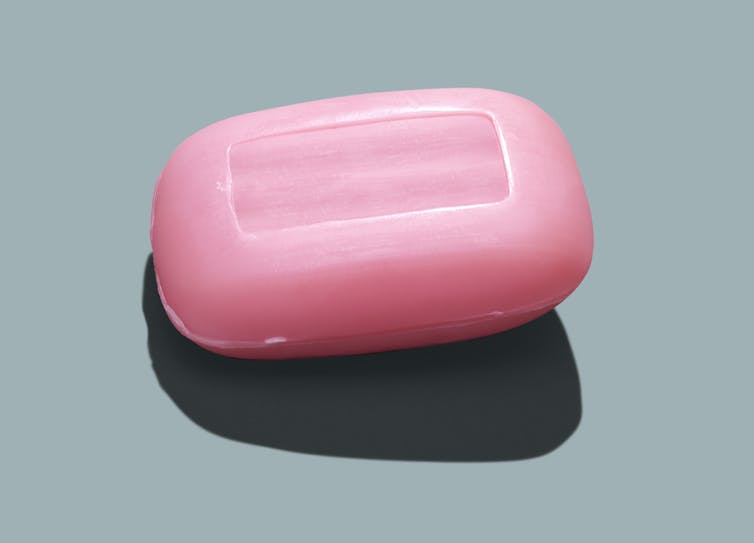
It’s common-sense advice. The surfactants found in soap lift germs from the skin, and water then washes them away. Soap is inexpensive and ubiquitous; it’s a consumer product found in every household across the country.
Yet few people know the long and dirty history of making soap, the product we all rely on to clean our skin. I’m a historian who focuses on material culture in much of my research. As I started digging into what’s known about soap’s use in the past, I was surprised to discover its messy origins.
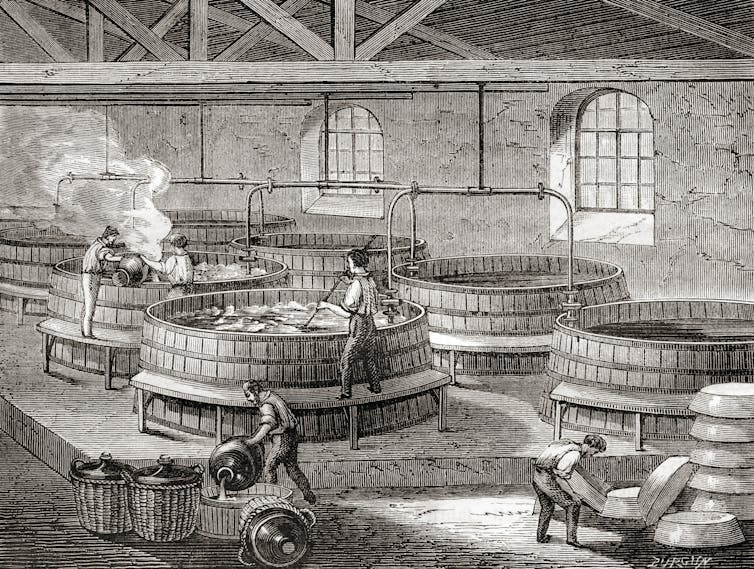
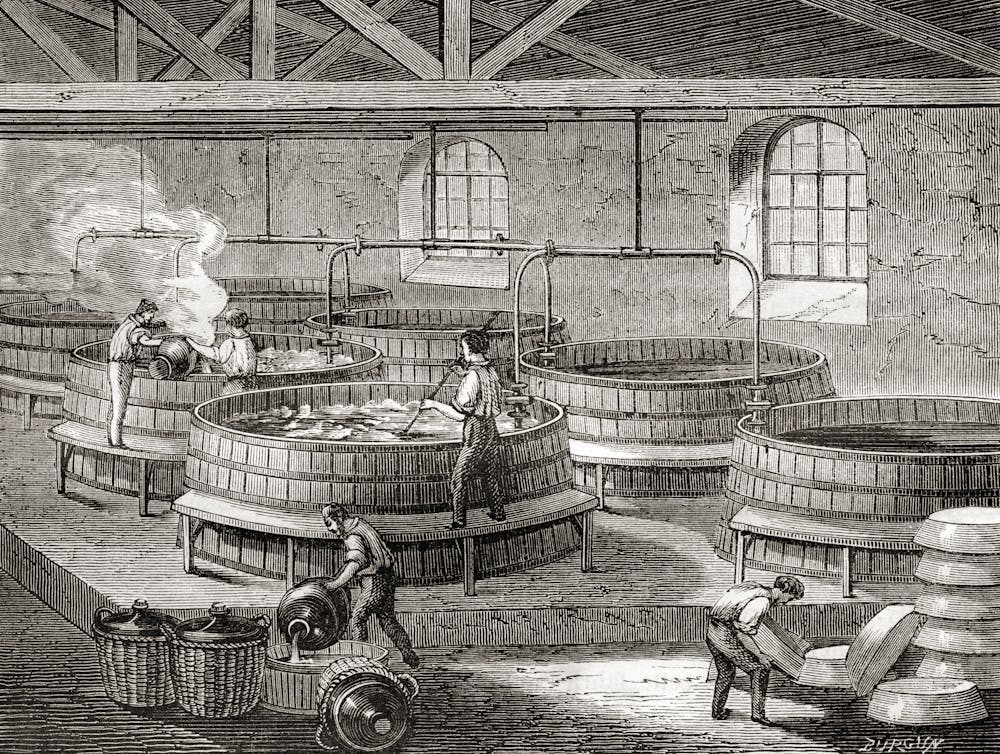
Ancient Mesopotamians were first to produce a kind of soap by cooking fatty acids – like the fat rendered from a slaughtered cow, sheep or goat – together with water and an alkaline like lye, a caustic substance derived from wood ashes. The result was a greasy and smelly goop that lifted away dirt.
An early mention of soap comes in Roman scholar Pliny the Elder’s book “Naturalis Historia” from A.D. 77. He described soap as a pomade made of tallow – typically derived from beef fat – and ashes that the Gauls, particularly the men, applied to their hair to give it “a reddish tint.”
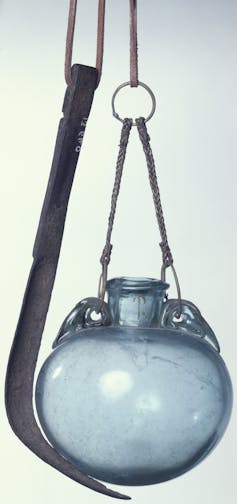
Ancient people used these early soaps to clean wool or cotton fibers before weaving them into cloth, rather than for human hygiene. Not even the Greeks and Romans, who pioneered running water and public baths, used soap to clean their bodies. Instead, men and women immersed themselves in water baths and then smeared their bodies with scented olive oils. They used a metal or reed scraper called a strigil to remove any remaining oil or grime.
By the Middle Ages, new vegetable-oil-based soaps, which were hailed for their mildness and purity and smelled good, had come into use as luxury items among Europe’s most privileged classes. The first of these, Aleppo soap, a green, olive-oil-based bar soap infused with aromatic laurel oil, was produced in Syria and brought to Europe by Christian crusaders and traders.
French, Italian, Spanish and eventually English versions soon followed. Of these, Jabon de Castilla, or Castile soap, named for the region of central Spain where it was produced, was the best known. The white, olive-oil-based bar soap was a wildly popular toiletry item among European royals. Castile soap became a generic term for any hard soap of this type.
The settlement of the American colonies coincided with an age (1500s-1700s) when most Europeans, whether privileged or poor, had turned away from regular bathing out of fear that water actually spread disease. Colonists used soap primarily for domestic cleaning, and soap-making was part of the seasonal domestic routine overseen by women.
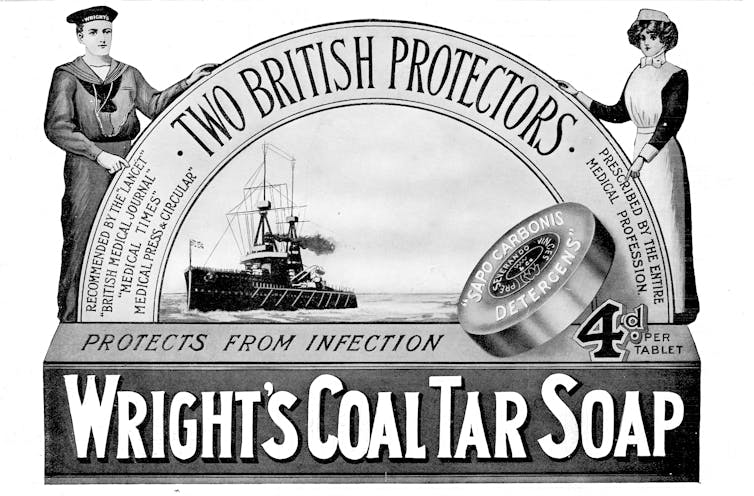
Companies began to develop and market a variety of new products to consumers. In 1879, P&G introduced Ivory soap, one of the first perfumed toilet soaps in the U.S. B.J. Johnson Soap Company of Milwaukee followed with their own palm-and-olive-oil-based Palmolive soap in 1898. It was the world’s best-selling soap by the early 1900s.
Soap chemistry also began to change, paving the way for the modern era. At P&G, decades of laboratory experiments with imported coconut and palm oil, and then with domestically produced cottonseed oil, led to the discovery of hydrogenated fats in 1909. These solid, vegetable-based fats revolutionized soap by making its manufacture less dependent on animal byproducts. Shortages of fats and oils for soap during World Wars I and II also led to the discovery of synthetic detergents as a “superior” substitute for fat-based laundry soaps, household cleaners and shampoos.
Today’s commercially manufactured soaps are highly specialized, lab-engineered products. Synthesized animal fats and plant-based oils and bases are combined with chemical additives, including moisturizers, conditioners, lathering agents, colors and scents, to make soaps more appealing to the senses. But they cannot fully mask its mostly foul ingredients, including shower gels’ petroleum-based contents.
Best wishes to our grade 12 learners who return to school today! It was a long stretch since 18 March when schools closed for the lockdown. We wish you all success!
A tree is known for its fruit and a physical/technical science teacher by his mask! A very enthusiastic Mr Johan Herbst of HTS Welkom decided to convey some visible scientific inspiration to his learners. For that, he borrowed some "atoms" from Einstein and the periodic table from Dmitri Mendeleev. And together, they will take the Covid-19 grade 12s to higher heights.
Mr Herbst has also made masks for his matrics, but this is only obtainable if they perform in the pre-set term two competitions. Grade 12s, here is a hint! Learn and work hard!!! This exclusive mask can be part of your school uniform.
Mr Herbst - thanks for this initiative. A dedicated teacher is pure aurum (Au)! If anybody is interested in having such masks, contact Mr Herbst at HTS Welkom (leave a message at 057 352 3255). He will gladly assist you!
A distance learning toolkit for parents is now available. It is aimed at giving parents an overview of the various educational platforms that will support the creation of a conducive learning environment at home, help with developing at-home digital learning skills, empower communication between parents and teachers and guide parents on ensuring family cyber wellness. This self-paced learning toolkit is divided into five toolboxes to guide your exploration of at-home learning. With self-paced learning, parents are able to navigate through the content resources to help to make learning conducive at home.
Toolbox 1: Parental Involvement Toolbox 2: Creating and Managing Learning environments Toolbox 3: Enable Communication Toolbox 4: Enable Learning Toolbox 5: Cyber Wellness Explore the website by using this link: https://fsdoeelearning.wixsite.com/parent-toolkit Refer to this post about the website for teachers.
This interesting article was recently posted by Ingrid Bradfield on the Facebook group RSG Sterre en Planete. How amazing things can turn out!
Photo via TASS
Soviet cosmonaut Sergei Krikalev was in space when the Soviet Union fell apart in 1991. Unable to return home, he ended up having to stay in space until further notice.The cosmonaut eventually returned to Earth on March 25, 1992, after 10 months in orbit - to a nation that was very different to what it was when he had left. The Soviet Union had fractured into 15 nations, presidents had changed, and even his hometown of Leningrad had become St. Petersburg. Interestingly, at the time, Krikalev was supposed to serve in the military reserve, and was almost issued a warrant for desertion – before the army realised that their reserve soldier was not even on the planet.
What happened to him? Currently, he is working as vice president of the S.P. Korolev Rocket and Space Corporation Energia according to this Wikipedia article. To read about Sergei Korolev, after whom this corporation was named, is another interesting journey. His involvement with Yuri Gagarin, for example, is so interesting! Here and here are two articles about Gagarin on this website.
Click here to go the page where you can download the revised annual teaching plans (ATPs) and other documents in view of the national lockdown due to Covid-19. Read the information on that page with attention. DBE circular S2 that accompanies these documents can be downloaded here.
If you want to return to the documents in future, remember to look under "Pages". The documents are also available on the website of DBE. Look under links for schools.
Click here to read President Cyril Ramaphosa's Covid-19 message of tonight as the country is moving towards level three. More information is available here:
LATE PROF. ANTON STOLTZ HAILED FOR HIS WORK TOWARDS FIGHT AGAINST COVID-19
Stoltz, who was the head of infectious diseases at the University of Pretoria and Steve Biko Hospital, died from complications during surgery on Thursday.
Tributes continue to pour in for one of South Africa’s leading infectious diseases specialist Professor Anton Stoltz.
Stoltz died this week from complications during surgery.
He was the head of infectious diseases at the University of Pretoria and Steve Biko Hospital.
The health fraternity, including the Gauteng health department, the South African Medical Association and the Medical Research Council have hailed the virologist for his contribution and response to the fight against COVID-19.
The readers of this website wish to convey their condolences to the Stoltz family.
Our second round of live chats on Facebook will DV be done by Mrs Busi Manchu and Mr Motsie Lethena today. Mrs Manchu will talk about organic reactions at 12:00 and physical properties at 15:00, while Mr Lethena will discuss the Doppler effect at 18:00.
Join the Facebook group called IBP - Internet Broadcast Project to see the videos (shown before the live chats) and the live chats themselves.
Our first Physical Sciences Facebook Live Chat will DV take place on Saturday, 16 May 2020. Collision theory, chemical equilibrium and acids and bases are in store for you and will be done by Mrs Busi Manchu from 12:00.
(C) Facebook Group: IBP - Internet Broadcast Project
Join the Facebook group called IBP - Internet Broadcast Project to see videos (shown before the live chats) and the live chats themselves.
Today, Mrs Manchu will discuss sections of the following papers, which you can download by clicking the links on each one below. They will take you directly to the papers instead of going to the normal repository of papers.
However, remember that question papers from more or less 2015 are available by going to "Pages" (on the left), then to the link "Question papers". Then you follow links from there to find what you need.